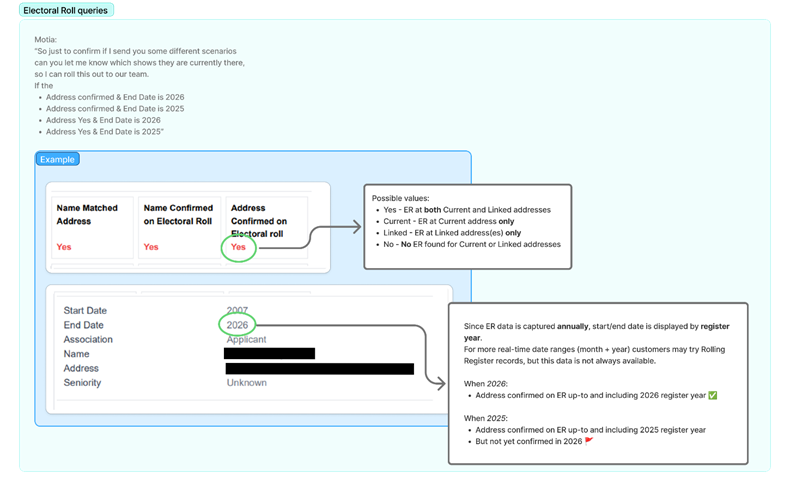
Your credit report may show Electoral Roll dates as a start and end period rather than the exact date you registered with your council. These dates usually show the earliest and latest years that a credit reference agency has recorded you as being registered at that address.
Start date
This usually indicates the first year you appear on the Electoral Roll at that address in the credit references data. It shows the earliest point in time from when it has recorded that you were registered to vote at that address. It is not the date you registered with the council, but the year from the historical data showing you on the roll.
End date
If present, an end date typically means that the Electoral Roll record covers more than one year and that CRA’s data shows you continuing to be on the roll through that later year. Once the period ends, it may mean that either:
- You were no longer registered there after that year, or
- The credit reference system simply marks the last full year they have data for you at that address.
How this fits with the UK Electoral Roll
The Electoral Roll (UK) is updated annually (usually published on 1st December for the next year) and then updated monthly with changes between January and September.
Credit reference agencies receive data from local councils and include it in your report to help verify your name, address, and stability of residence.
Key points
- It may not show the exact date you registered with your local council — the report often abbreviates dates to years or periods rather than specific days.
- An end date may not always mean removal from the Electoral Roll — it may simply reflect the last full year of data the CRA has from its dataset, especially if you’ve been continuously registered.
Was this article helpful?
That’s Great!
Thank you for your feedback
Sorry! We couldn't be helpful
Thank you for your feedback
Feedback sent
We appreciate your effort and will try to fix the article